-
Interview with Geoffrey 'Geoff' Alger
Geoffrey 'Geoff' Alger and Logan Dovalina
Geoff Alger (b. 1961, Glen Cove, New York) was interviewed on June 23–24, 2026, at his home in McAllen, Texas, by Logan Dovalina. The interview covers Alger’s life and career as a museum professional deeply rooted in Rio Grande Valley history.
Alger recounts his family’s 1971 move from Long Island to McAllen, his parents’ museum careers (McAllen International Museum, Museum of South Texas History, Confederate Air Force), and his own path from a teenage volunteer to decade-long employment at the Confederate Air Force museum. He discusses later roles as curator and exhibits specialist at museums in Oregon and the Valley (Tillamook Air Museum, Evergreen Air & Space Museum, McAllen Heritage Center, Weslaco Cultural Museum, and Mission Historical Museum), including the major transformation of Mission’s exhibits during the COVID-19 closure.
Substantial portions focus on local history and memory: the citrus landscape of South Bentsen Road and the Neuhaus/Bentsen properties; canal systems and the former Botanical Gardens; cemeteries (Laurel Hill and San José); architecture and Southside Mission; folklore (Big Bird, the Devil in the Disco, La Llorona); and environmental change. Alger also reflects on the value of oral history, the work of figures such as Fran Isbell and Spud Brown, and his own efforts to create research libraries and document vanishing landscapes and stories.
-
Interview with Rosa Elia Garza
Rosa Elia Garza and Logan Dovalina
Rosa Elia Garza (née Peña) was born on August 19, 1947, in Arcabuz, Tamaulipas, Mexico, and immigrated to the United States at four months of age with her parents, Porfirio Peña and Elodia González Peña. The youngest of eight sisters in a family with no sons, she grew up in Monte Alto, Texas, where her family built a life centered on hard work, family unity, and the pursuit of a better future after selling their property in Mexico. From age six, Rosa worked in the cotton fields alongside her mother and sisters, eventually traveling seasonally with other Valley families in a canvas-covered truck to harvest crops in Robstown and Corsicana. She recalls the Bracero Program era, modest housing conditions—including initially sharing a two-room house—and the daily realities of agricultural labor that defined her childhood and taught her the value of contribution and resilience. In school, Rosa navigated the challenges faced by Mexican-American students in the 1950s and 1960s, including automatic placement in “beginner” classes and strict prohibitions against speaking Spanish, enforced through corporal punishment and writing lines on the chalkboard. Despite these assimilation pressures, she excelled in fast-pitch softball (as catcher) and basketball (top scorer), crediting her demanding yet inspiring coach, Mr. Sparkman, with fostering resilience and providing memorable field trips—including a near-drowning incident at Padre Island that she describes as a miracle—and the San Antonio Livestock Show. After graduating from Edcouch-Elsa High School in 1966, Rosa held jobs in okra packing sheds (where she became a model worker at age 15–16), plastics manufacturing, and as a teacher aide in migrant education programs. She later worked 31 years as a certified paraprofessional in the Pharr-San Juan- Alamo (PSJA) school district, notably at the innovative open-concept Raul Longoria Elementary (a model school) and Buckner Elementary. In 1967 she met Jose “Joe” Garza at Delta Lake; they married on September 20, 1968, at the Rio Farms Reception Center. They purchased their home in Hub City Acres, Pharr, in 1971 for $7,000. Their first daughter, Iris, was born in July 1969 on the day of the Apollo 11 splashdown. This interview, conducted by her grandson Logan Dovalina, offers a firsthand account of Mexican- American immigrant experiences, migrant and agricultural labor, mid-century education and language policies, women’s athletics and work, family dynamics across generations, and everyday community life in Deep South Texas. It provides valuable historical insight into the social, economic, and cultural fabric of the Rio Grande Valley from the late 1940s through the early 1970s and serves as Part One of a planned multi-session oral history for the anthology.
-
Interview with Charles 'Chuck' A. Malloy III
Charles 'Chuck' A. Malloy III and Logan Dovalina
This oral history transcript (dated June 4, 2026, Laguna Vista, TX) features Charles A. “Chuck” Malloy III, a prominent South Texas horticulturist, Master Gardener, and longtime President of the Palm Society of South Texas. Interviewed by Logan Dovalina for the Rio Grande Valley Legacy Anthology, Vol. 1, Malloy recounts his life journey—from his 1953 birth in Tallahassee, Florida, as a military “Army brat,” early inspiration from his grandfather’s forestry and camellia work, and youthful gardening experiences, to military service during Vietnam, college on the GI Bill, and a full career followed by retirement in 2013.
The interview details his engagement with palms and native plants in the Rio Grande Valley, including leadership roles in the Cameron County Master Gardeners, transforming the Palm Society of South Texas into a incorporated nonprofit, forging partnerships with the Gladys Porter Zoo and Sabal Palm Sanctuary, and organizing the 2025 International Palm Society “Weekender” event. He also discusses advocacy efforts to designate Sabal mexicana as Texas’s official state palm, proper palm care and pruning practices, local palm history, and memorable international travels with the IPS to Peru (Amazon), Vietnam, and Thailand.
The transcript provides insights into horticultural passion, community leadership, environmental stewardship, and cultural heritage in South Texas.
-
Interview with Cecilia 'Sue' Sill
Cecilia 'Sue' Sill and Logan Dovalina
Cecilia 'Sue' Sill (b. 1939, Woodward, Oklahoma) recounts a life shaped by mobility, scientific curiosity, and engagement with the natural world of South Texas and Mexico. The daughter of a pipeline welder, she moved frequently as a child before settling for a time in Pharr, Texas, in 1950. She later spent roughly forty years in Corpus Christi, where she raised two sons, pursued higher education later in life, and earned a Ph.D. focused on the systematics of Tillandsia (air plants), describing several new species centered in Mexico.
After her divorce in 1990, Sill lived for eight years on a mountainside ranch near Pátzcuaro, Michoacán, collecting botanical specimens, leading small nature and birding tours, and immersing herself in the region’s landscapes and indigenous cultures. She also directed the Corpus Christi Botanical Gardens and has long been an active painter and orchid enthusiast. In this interview she reflects on family history, botanical fieldwork, life in Mexico, artistic practice, and the practical and emotional dimensions of aging while remaining connected to the places and plants that defined her career.
-
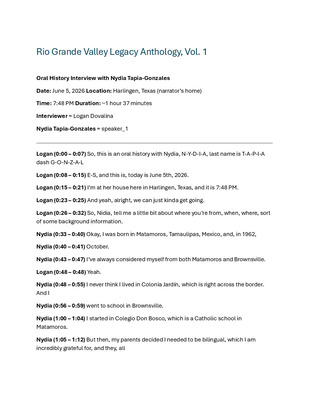
Interview with Nydia Tapia-Gonzales
Nydia Tapia-Gonzales and Logan Dovalina
In this oral history interview conducted on June 5, 2026, in Harlingen, Texas, Nydia Tapia-Gonzales (b. 1962, Matamoros, Tamaulipas) reflects on her bicultural life along the U.S.–Mexico border and her long engagement with architecture, tourism, and historic preservation in the Rio Grande Valley.
Born and raised in Matamoros’s Colonia Jardín while attending schools in Brownsville (Colegio Don Bosco and Incarnate Word Academy), Tapia-Gonzales describes a fluid childhood spent moving between the two cities. She discusses her early fascination with architecture—sparked by her grandmother’s traditional house, mid-century modern homes in Matamoros, and her father’s newspaper work—as well as her teenage work as an interior decorator and later studies in design.
The interview covers her first marriage, the birth of three children, a difficult divorce, and her relocation to the United States in the late 1990s. She details her partnership with second husband Guadalupe Gonzales in operating Gray Line Tours and other tourism businesses that served Winter Texans, organizing multi-day trips into interior Mexico until rising insecurity ended the industry around 2009. She later served as director of the Harlingen Convention and Visitors Bureau.
A substantial portion of the conversation focuses on Tapia-Gonzales’s discovery and advocacy of mid-century modern architecture in the Valley, particularly the Laurel Park neighborhood of Harlingen. She recounts meeting architectural historian Stephen Fox, researching the work of architects such as John York and Alan Taniguchi, founding the RGV Mod website in 2014, and organizing public house tours. She also addresses the neglected Neutra house in Brownsville and broader challenges of architectural preservation amid contemporary development pressures, cookie-cutter housing, and a regional preference for Mission Revival styles.
Tapia-Gonzales further explores family history, including Spanish colonial land grants in Mier, Camargo, and Garciasville, successive migration waves from the Mexican Revolution and later narcoviolence, and the distinctive hybrid cultural identity of the border region. Throughout the interview she reflects on themes of belonging (“no soy de aquí ni de allá”), the loss of cross-border community, and the difficulty of articulating a coherent Valley identity in the face of rapid change.
-
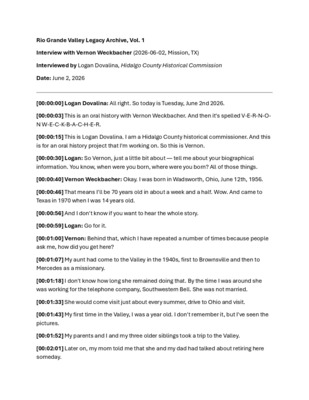
Interview with Vernon Weckbacher
Vernon Weckbacher and Logan Dovalina
In this oral history interview conducted on June 2, 2026, Logan Dovalina interviews Vernon Weckbacher (born 1956 in Wadsworth, Ohio), a longtime Rio Grande Valley resident and former museum professional. Weckbacher recounts his family’s relocation to Mercedes, Texas, in 1970 at age 14, his high school and college years at Pan American University (BFA in Art, minor in Geology), and his 26-year career at the McAllen International Museum (now IMAS), where he worked on exhibits and notably helped build the Mexican folk art collection through acquisitions in Oaxaca and Michoacán.
He later served as collections manager at the Mission Historical Museum (2009–2014+), where he focused on organizing archives, cataloging major donations including the Cleo Dawson and Conway papers, and preserving significant records such as the Flores Funeral Home journals. The interview explores Valley history, including the agricultural era, prominent families (Bentsen, Shary, Schwartz), the Citrus Fiesta, and the transformative impact of the 1983 freeze.
Weckbacher also shares personal memories of witnessing Presidents Nixon (1972), Carter (1976), Clinton, and George W. Bush in the Valley, as well as his long-term involvement with the Valley Symphony Chorale since 1988. Throughout the conversation, he emphasizes the importance of preserving everyday history and the value of archives in documenting community life.
The interview provides rich firsthand insights into cultural, artistic, and historical development in the Rio Grande Valley from the 1970s through the early 21st century.
-
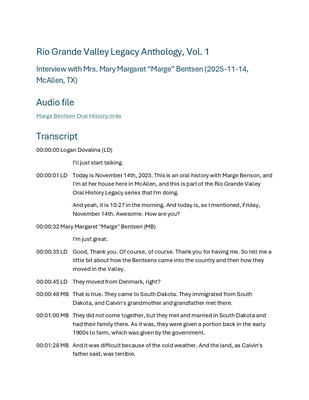
Interview with Mary Margaret “Marge” Bentsen
Mary Margaret Bentsen and Logan Dovalina
Mary Margaret “Marge” Bentsen (born ca. 1930, Center, Texas), widow of Calvin Bentsen (1925–2024) and daughter-in-law of Elmer Bentsen, recounts the Danish-American Bentsen family’s migration from the harsh winters of South Dakota to the Rio Grande Valley in 1918–1919 and their role in the region’s citrus, banking, real estate, and civic development.
Drawn south by stories of strawberries at Christmas and the promise of year-round farming, the family settled along what became Bentsen Road. Elmer and Lloyd Bentsen Sr. formed a partnership that developed extensive citrus groves, operated the First National Bank chain across the Valley, and engaged in real estate. Marge describes the pre-freeze Mission and McAllen as a fragrant sea of citrus, the springtime scent of orange blossoms that once announced the Valley’s border miles away, and a time when major streets ended in dirt at Jackson Avenue.
After meeting Calvin at Hockaday/SMU in Dallas and marrying in 1949, Marge moved to the Valley in 1950. She chronicles Calvin’s entrepreneurial path: founding Tex-Air (one of the Valley’s first air-conditioning companies), banking directorships, mineral interests, real-estate ventures, and development of the Hidalgo flea market and shopping center. Both were deeply involved in civic life; Calvin as a founder and long-time vice-president of the Gladys Porter Zoo board, hospital trustee, and passionate conservationist and hunter; Marge in the founding of the International Museum of Art & Science (IMAS) and First Methodist Church activities.
The interview touches on the family’s sprawling achievements (U.S. Senator Lloyd Bentsen Jr., Secretary of the Interior Gail Norton, Congressman Ken Bentsen, architects, bankers, and ranchers), the restoration of the ca.-1860s Lacoma Ranch headquarters (now historically marked), and Marge’s gratitude for the strong work ethic, family closeness, and faith instilled by the immigrant generation. At 98, she reflects nostalgically yet appreciatively on the Valley’s transformation from citrus paradise to modern urban corridor, declaring it still “the most wonderful place to live.”
-
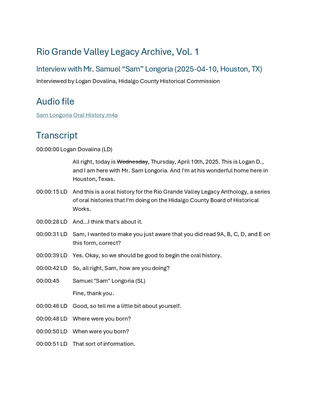
Interview with Samuel "Sam" Longoria
Samuel Longoria, Logan Dovalina, and Hidalgo County Historical Commission
Samuel “Sam” Longoria (b. March 11, 1951, Austin), a seventh-generation Texan and retired 40-year Assistant U.S. Attorney, narrates his family’s deep roots in the lower Rio Grande Valley and the remarkable political and professional ascent of his father, the Hon. Raul Longoria (1921–2001).
The Longoria family traces its presence on the north bank of the Rio Grande to the 1749 Escandón colonization, receiving Porción 94 near present-day Rio Grande City. Sam details the Spanish porción system, the family’s hidalgo status, and the eventual sale of the last ancestral tract after 275 years. His mother’s Anglo-Saxon from Central Texas met his father at the University of Texas, where Raul, a World War II veteran who crossed the Atlantic on troop ships and served in occupied Germany, used the GI Bill to earn his undergraduate and law degrees (1952).
The family relocated to Pharr in 1952. Raul Longoria rapidly rose from assistant district attorney to private practice with Joe Evans in Edinburg, then entered politics: state representative (1961–1972), state senator (1973–1980), and 139th District Court judge (1981–1992). Sam vividly recalls the excitement of the 1960 Kennedy-Johnson campaign, his father’s legislative leadership, the famous 1979 “Killer Bees” walkout that derailed John Connally’s presidential hopes, and the 1978 day Raul Longoria served as ceremonial Governor of Texas.
Sam reflects on childhood in 1950s–1960s Pharr before air-conditioning, the magic of citrus groves and vegetable fields stretching between discrete towns, the fragrance of orange blossoms, rows of Egyptian palm trees as windbreaks, and the 1983 freeze that ended the citrus era and spurred urbanization. He also discusses his own legal career (Assistant U.S. Attorney, Southern District of Texas, 1978–2016), his siblings’ accomplishments, and pride in the Raul Longoria Elementary School (Pharr) and Raul Longoria Road (San Juan) named in his father’s honor.
-
Interview with Bill C. Robertson
Bill C. Roberston and Logan Dovalina
Bill Robertson (September 15, 1943-June 20, 2026), a lifelong resident of Mission and McAllen, provides a first-hand account of the pioneer era and mid-20th-century social fabric of Mission, Texas, with particular emphasis on the exclusive Shary Heights subdivision.
Robertson traces his family’s arrival: his paternal grandfather entered the cotton business in Mission in 1908, while his maternal grandfather relocated from Vernon, Texas, to establish a citrus grove after purchasing land from developer John H. Shary. He vividly recalls the town’s earliest days, including cross-border bandit activity, homes lost to fire, and freezes, and the tight-knit circle of founding families (Shary, Conway, Bentsen, Buescher, Landry, Jeffries, Duncan, Armstrong, Walsh, Volz, Melch, and others) whose children and grandchildren he knew personally.
The interview offers a detailed “mental map” of 1940s–1960s Shary Heights when it was still almost entirely brush and ebony thickets, with only a handful of homes along palm-lined cul-de-sacs and irrigation canals. Robertson recounts building hunting blinds on lots that later became neighbors’ yards, swimming in the Little Melch canal behind his house, and the arrival of the first additional residences (Armstrong, Zweifel, Campbell, Bentsen, etc.), and the dramatic transformation of the neighborhood from isolated citrus grove to upscale subdivision.
Additional topics include downtown Mission’s commercial landscape (Shary Building, post office, banks, hardware and lumber yards, theaters), prominent local figures such as Judge Strickland and postmaster Flint Sorrell, the interconnected citrus and banking families, the impact of devastating freezes, and Robertson’s own experiences with polio as a child, big-game hunting worldwide, art collecting (Porfirio Salinas, Robert Wood, David Shepherd), and extensive travel, including 35 years of owning a second home in Santa Fe, New Mexico.
Throughout, Robertson expresses nostalgia for Mission’s conservative, close-knit past and appreciation for efforts to document its history.
-

Interview with William Smid - Part 01
William Smid and Robert Everett Norton
Part 1 of 3.
- 00:00 - Introduction
- 00:52 - Father, mother, birth and childhood.
- 07:00 - Parent's farming practices.
- 07:37 - Caring for horses and farming.
- 27:36 - School.
- 30:20 - German language and community, speaking English in school, and bilingual education.
- 37:34 - Transitioning to high school.
- 39:42 - College and teaching.
- 44:47 - The late 20's and a "running away".
- 59:00 - Picking cotton.
-

Interview with William Smid - Part 02
William Smid and Robert Everett Norton
Part 2 of 3.
- 00:00 - 1929 and trying to get a job, and stories related to working.
- 15:47 - Getting injured and spending time in the hospital.
- 20:55 - Back at work and gambling.
- 22:39 - Returning home.
- 30:21 - Teaching.
- 37:30 - After teaching, hauling gravel, Texas Chiropractic College and work as a chiropractor.
- 55:10 - Walking club.
-

Interview with William Smid - Part 03
William Smid and Robert Everett Norton
Part 3 of 3.
- 00:00 - Continued from part 02
- 15:07 - World War II.
- 29:30 - Marriage.
- 30:20 - After the war, moving to St. Louise and having a son.
- 38:10 - 1949, moving to the Rio Grande Valley.
- 47:47 - Flying equipment changes, buying an airstrip and pesticides.
-

Interview with Antonio Villegas Jr - Part 01
Antonio Villegas Jr. and Robert Everett Norton
Antonio Victor Villegas was born in Pharr in 1920. He talks about his grandparents. He reminisces about: farming and vegetables grown, diet, making cheese, education, vegetation present before the clearing for agriculture lands, how jacales were made, people and homes being taken away with river flooding, Rio Grande river flooding, Carrizitos, crossing the Rio Grande on boats, smuggling, and incest.
-

Interview with Max H. Greenwood and Evelyn Hill Dillon - Part 01
Max H. Greenwood and Robert Everett Norton
Part 1 of 2.
-

Interview with Max H. Greenwood and Evelyn Hill Dillon - Part 02
Max H. Greenwood and Robert Everett Norton
Part 2 of 2.
-

Interview with Ewart Sterling Hawthorne
Ewart Sterling Hawthorne and Robert Everett Norton
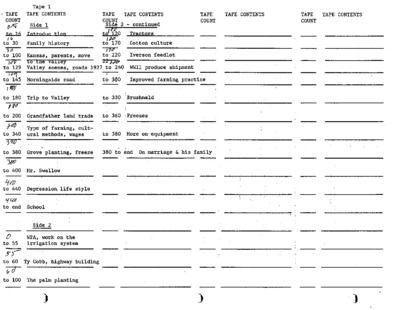
Ewart Sterling Hawthorne tells about the end of the Civil War and its effects on his family, farm, and school life during horse and buggy days. He also talks about C.H. Swallow & Co. in land business and moving to the Valley.
-

Interview with Weldon C. Blackwell
Weldon C. Blackwell and Glenn Housley
Weldon C. Blackwell tells about the early days of Weslaco, including his home life, church, and family.
-
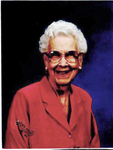
Interview with Frances Wood Borman
Frances Wood Borman and Betty Fogarty
Frances Wood Borman tells of her family moving to the Valley from the North in the early part of the century. She describes family values, her way of life as a child and young housewife.
-

Interview with Maurice Boyd Cramer
Maurice Boyd Cramer and Robert Everett Norton
Maurice Boyd Cramer born on 12 December 1916, in Sarcoxie, Jasper, Missouri, tells of early life in Missouri, an excursion train to the Valley, Hidalgo County Irrigation District #2, pump house in Hidalgo, Camp Ebenezer (Alamo), dairy and cotton farming, early San Juan schools, and flood control. He died on 3 July 2004, in Corpus Christi, Texas.
-

Interview with Maudie Henson Finney
Maudie Henson Finney and Carole B. Turner
Maudie Henson Finney was born on April 16, 1913, in Senath, Missouri. Henson talks extensively about her long career in the medical field as a school nurse, a hospital nurse, a hospital administrator and a public health nurse. She also discusses her hobby of swimming and her volunteer work with various community and professional organizations. Near the end of the interview, Henson briefly discusses her grown children.
-

Interview with Oliver Cromwell Aldrich, Jr.
Oliver Cromwell Aldrich Jr. and Robert Everett Norton
Oliver Cromwell Aldrich, Jr. (1918-1993) is interviewed by Robert Norton on 1992-04-24 in Houston, Texas. Aldrich recollects his life in Hidalgo County, Texas (San Juan and Edinburg) from the 1920's through the 1950's. He talks about construction of highways, floodways, schooling, agriculture, personalities, frequency of freeze, and river.
-

Interview with Nancy Fox - Part 01
Nancy Fox and Carole B. Turner
Nancy Fox tells about family life in the late 1930's and about the first hospital in McAllen.
-

Interview with Nancy Fox - Part 02
Nancy Fox and Carole B. Turner
Nancy Fox tells about family life in the late 1930's and about the first hospital in McAllen.
Printing is not supported at the primary Gallery Thumbnail page. Please first navigate to a specific Image before printing.