-
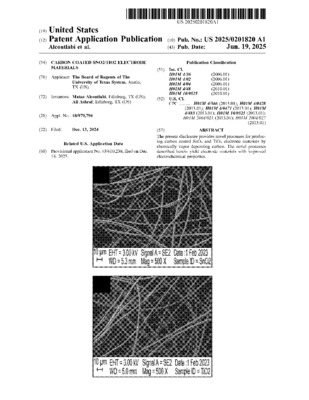
Carbon Coated SnO2/TiO2 Electrode Materials
Mataz Alcoutlabi and Ali Ashraf
The present disclosure provides novel processes for producing carbon coated SnO2 and TiO2 electrode materials by chemically vapor depositing carbon. The novel processes described herein yield electrode materials with improved electrochemical properties.
-
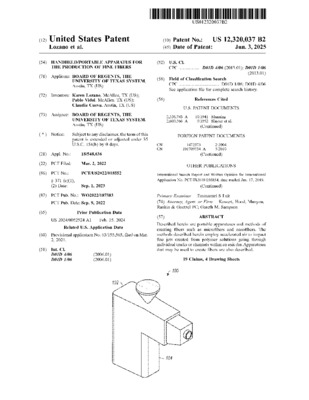
Handheld/Portable Apparatus for the Production of Fine Fibers
Karen Lozano, Pablo Vidal, and Claudia Cueva
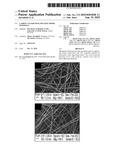
Described herein are portable apparatuses and methods of creating fibers, such as microfibers and nanofibers. The methods described herein employ accelerated air to impact fine jets created from polymer solutions going through individual tracks or channels within an exit die. Apparatuses that may be used to create fibers are also described.
-
In-Situ Formation of Two-Dimensional (2D) Nanoparticles within Elastomers for Electrochemical Sensing
Jennifer K. Lynch-Branzoi, Ali Ashraf, Ashiqur Rahman, and Nazmul Islam
Sensors employing elastomers enhanced with electrically conductive 2D nanoparticles are provided. The nanoparticles are formed by applying shear to layered materials present in elastomer precursors (e.g., elastomeric monomer(s) and/or curing agent(s)). Subsequent exfoliation of the layers occurs directly within the precursor and/or curing agent. The cured elastomer nanocomposites can be employed for electrochemical sensing, flexible touchpads, pressure sensors, and wireless sensors, amongst other applications.
-
Nanofiber Systems as Meat Substitute
Victoria Padilla, Karen Lozano, and Narcedalia Anaya-Barbosa
Methods for producing a meat substitute with plant-based fat contents are disclosed. The methods include the use of protein and/or polysaccharide polymer with fibrillar properties in combination with protein sources of essential amino acids such as plant-based protein. These polymers may be mixed together and then combined with an oil phase emulsion to produce a precursor emulsion. The precursor emulsion may then be processed into three-dimensional fiber structures that include muscle-like fibers with fat encapsulation of the proteins. A contemplated method for forming the fibers includes centrifugally spinning the precursor emulsion to form the fibers.
-
Encapsulation of Bioactive Ingredients by Multiplex Emulsion
Karen Lozano, Victoria Padilla, and Acharan S. Narula
Described herein are various three-dimensional fiber structures that have multiple polymer fiber layers with an active therapeutic agent entrained in the polymer fiber layers. Further described are methods for forming the three-dimensional fiber structures where the method includes centrifugal spinning of an emulsion containing polymer(s) and the active therapeutic agent(s).
-
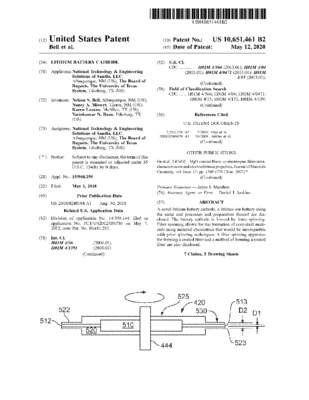
Lithium Battery Cathode
Nelson S. Bell, Nancy A. Missert, Karen Lozano, and Yatinkumar N. Rene
A novel lithium battery cathode, a lithium ion battery using the same and processes and preparation thereof are disclosed. The battery cathode is formed by force spinning. Fiber spinning allows for the formation of core-shell materials using material chemistries that would be incompatible with prior spinning techniques. A fiber spinning apparatus for forming a coated fiber and a method of forming a coated fiber are also disclosed.
-
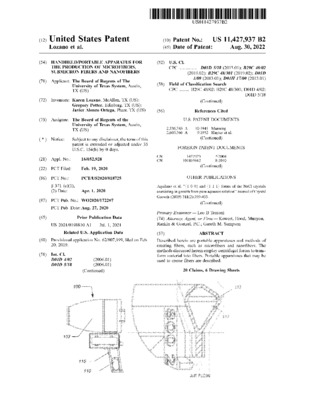
Handheld/Portable Apparatus for the Production of Microfibers, Submicron Fibers, and Nanofibers
Karen Lozano, Gregory Potter, and Javier Alonzo Ortega
Described herein are portable apparatuses and methods of creating fibers, such as microfibers and nanofibers. The methods discussed herein employ centrifugal forces to transform material into fibers. Portable apparatuses that may be used to create fibers are described.
-
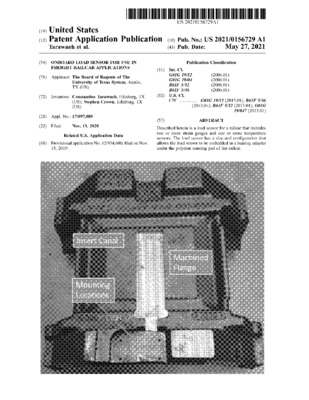
Onboard Load Sensor for Use in Freight Railcar Applications
Constantine Tarawneh and Stephen Crown
Described herein is a load sensor for a railcar that includes one or more strain gauges and one or more temperature sensors. The load sensor has a size and configuration that allows the load sensor to be embedded in a bearing adapter under the polymer steering pad of the railcar.
-
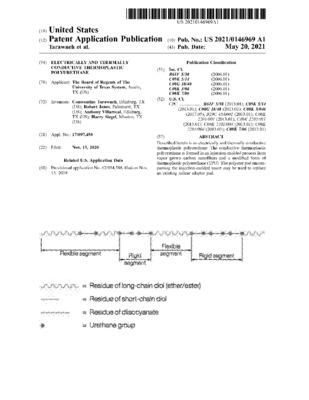
Electrically and Thermally Conductive Thermoplastic Polyurethane
Constantine Tarawneh, Robert Jones, Anthony Villarreal, and Harry Siegel
Described herein is an electrically and thermally conductive thermoplastic polyurethane. The conductive thermoplastic polyurethane is formed in an injection-molded process from vapor grown carbon nanofibers and a modified form of thermoplastic polyurethane (TPU). The polymer pad encompassing the injection-molded insert may be used to replace an existing railcar adapter pad.
-
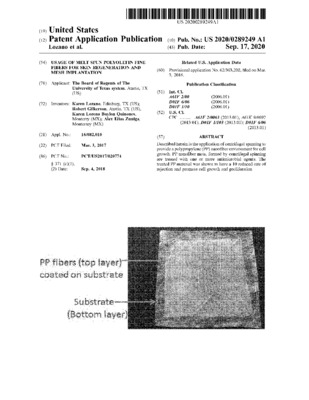
Usage of Melt Spun Polyolefin Fine Fibers for Skin Regeneration and Mesh Implantation
Karen Lozano, Robert Gilkerson, Karen Lorena Baylon Quinones, and Alex Elias Zuniga
Described herein is the application of centrifugal spinning to provide a polypropylene (PP) nanofiber environment for cell growth. PP nanofiber mats, formed by centrifugal spinning are treated with one or more antimicrobial agents. The treated PP material was shown to have a 10 reduced rate of rejection and promote cell growth and proliferation.
-
Mechanoluminescence Polymer Doped Fabrics and Methods of Making
Karen Lozano, Yuanbing Mao, Carlos Hernandez, and Misael E. Martinez
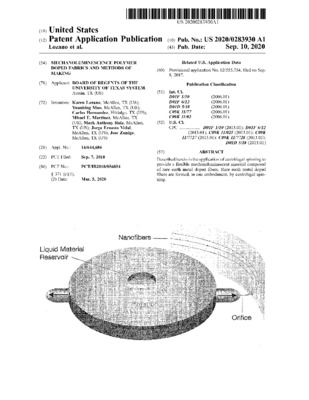
Described herein is the application of centrifugal spinning to provide a flexible mechanoluminescent material composed of rare earth metal doped fibers. Rare earth metal doped fibers are formed, in one embodiment, by centrifugal spinning.
-
Desalination Device
Yingchen Yang
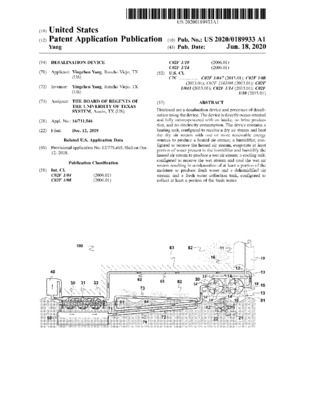
Disclosed are a desalination device and processes of desalination using the device. The device is directly ocean-situated and fully nature-powered with on intake, no brine production, and no electricity consumption. The device contains a heating unit, configured to receive a dry air stream and heat the dry air stream with one or more renewable energy sources to produce a heated air stream; a humidifier, configured to receive the heated air stream, evaporate at least portion of water present in the humidifier and humidify the heated air stream to produce a wet air stream, a cooling unit, configured to receive the wet stream and cool the wet air stream resulting in condensation of at least a portion of the moisture to produce fresh water and a dehumidified air stream; and a fresh water collection tank, configured to collect at least a portion of the fresh water.
-
HPLC-PDA Method and Uses Thereof in Phytoestrogen Measurement
Maria Teresa Aguirre
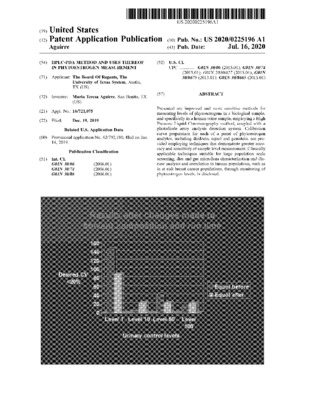
Presented are improved and more sensitive methods for measuring levels of phytoestrogens in a biological sample, and specifically in a human urine sample, employing a High Pressure Liquid Chromatography method, coupled with a photodiode array analysis detection system. Calibration curve preparation for each of a panel of phytoestrogen analytes, including daidzein, equol and genistein, are provided employing techniques that demonstrate greater accuracy and sensitivity of sample level measurement. Clinically applicable techniques suitable for large population scale screening, diet and gut microflora characterization and disease analysis and correlation in human populations, such as in at risk breast cancer populations, through monitoring of phytoestrogen levels, is disclosed.
-
Scalable and Facile in Situ Synthesis of Nanoparticles Resulting in Decorated Multifunctional Fibers
Karen Lozano and Mandana Akia
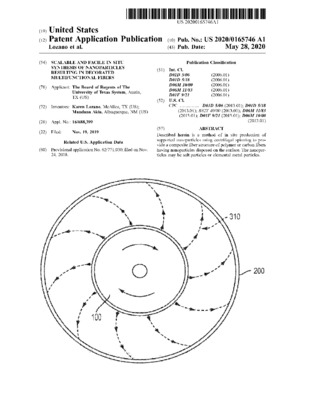
Described herein is a method of in situ production of supported nanoparticles using centrifugal spinning to provide a composite fiber structure of polymer or carbon fibers having nanoparticles disposed on the surface. The nanoparticles may be salt particles or elemental metal particles.
-
Lithium Battery Cathode
Nelson S. Bell, Nancy A. Missert, Karen Lozano, and Yatinkumar N. Rene
A novel lithium battery cathode, a lithium ion battery using the same and processes and preparation thereof are disclosed. The battery cathode is formed by force spinning. Fiber spinning allows for the formation of core-shell materials using material chemistries that would be incompatible with prior spinning techniques. A fiber spinning apparatus for forming a coated fiber and a method of forming a coated fiber are also disclosed.
-
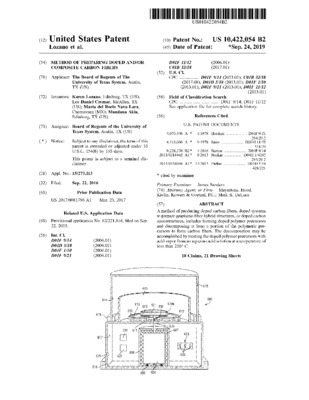
Method of Preparing Doped and/or Composite Carbon Fibers
Karen Lozano, Lee Daniel Cremar, Maria del Rocio Nava Lara, and Mandana Akia
A method of producing doped carbon fibers, doped systems to prepare graphene-fiber hybrid structures, or doped carbon nanostructures, includes forming doped polymer precursors and decomposing at least a portion of the polymeric precursors to form carbon fibers. The decomposition may be accomplished by treating the doped polymer precursors with acid vapor from an aqueous acid solution at a temperature of less than 250° C.
-
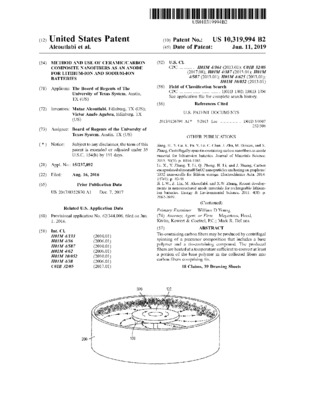
Method and Use of Ceramic/Carbon Composite Nanofibers as an Anode for Lithium-Ion and Sodium-Ion Batteries
Mataz Alcoutlabi and Victor Anafo Agubra
Tin-containing carbon fibers may be produced by centrifugal spinning of a precursor composition that includes a base polymer and a tin-containing compound. The produced fibers are heated at a temperature sufficient to convert at least a portion of the base polymer in the collected fibers into carbon fibers comprising tin.
-
Method of Producing Controlled Material Properties of Glass Structures Manufactured from Micron and Sub-Micron Glass Powders and Applications Thereof
Arturo Alejandro Fuentes, Kamal Sarkar, Stephen Crown, and Horacio Vasquez
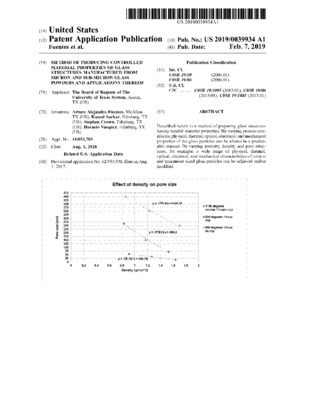
Described herein is a method of preparing glass structures having tunable material properties. By varying process conditions, physical, thermal, optical, electrical, and mechanical properties of the glass particles can be altered in a predictable manner. By varying porosity, density, and pore structures, for example, a wide range of physical, thermal, optical, electrical, and mechanical characteristics of micron and nanometer sized glass particles can be achieved and/or modified.
-
Method of Preparing Carbon Fibers
Karen Lozano and Lee Daniel Cremar
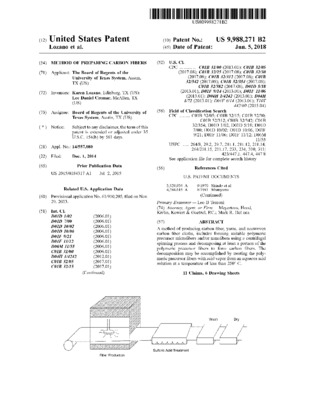
A method of producing carbon fiber yarns, and nonwoven carbon fiber cloths, includes forming suitable polymeric precursor microfibers and/or nanofibers using a centrifugal spinning process and decomposing at least a portion of the polymeric precursor fibers to form carbon fibers. The decomposition may be accomplished by treating the polymeric precursor fibers with acid vapor from an aqueous acid solution at a temperature of less than 250° C.
-
Wireless Sensor for Electromagnetically Shielded Applications and Method of Communication
Kye-Hwan Lee, Heinrich D. Foltz, and Rajiv V. Nambiar
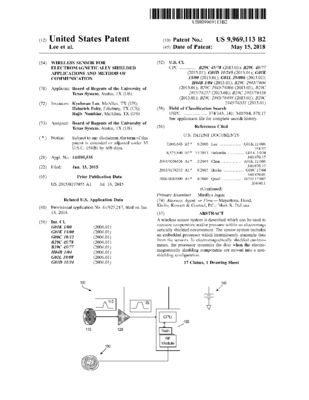
A wireless sensor system is described which can be used to measure temperature and/or pressure within an electromagnetically shielded environment . The sensor system includes an embedded processor which intermittently transmits data from the sensors. In electromagnetically shielded environments, the processor transmits the data when the electromagnetically shielding components are moved into a non-shielding configuration .
-
Cobalt-Based MRI Contrast Agent and Imaging System
Steven J. Frank and Karen Matirosyan
Novel, non-toxic cobalt-based contrast and imaging agents for use in enhanced medical imaging modalities and processes are described, as well the manufacture of markers containing such contrast agents is described, and uses for such imaging markers and contrast agents in a variety of therapeutic applications and devices.
-
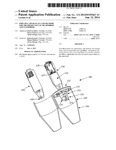
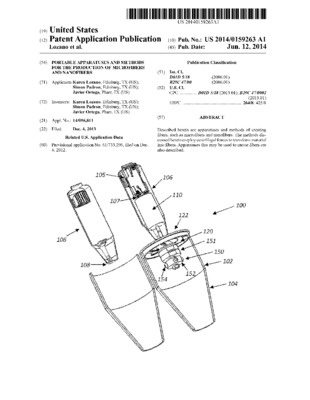
Portable Apparatuses and Methods for the Production of Microfibers and Nanofibers
Karen Lozano, Simon Padron, and Javier Ortega
Described herein are apparatuses and methods of creating fibers, such as microfibers and nanofibers. The methods discussed herein employ centrifugal forces to transform material into fibers. Apparatuses that may be used to create fibers are also described.
-
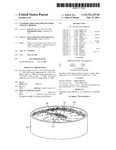
Superfine Fiber Creating Spinneret and Uses Thereof
Karen Lozano and Kamalaksha Sarkar
Apparatuses and methods for the production of superfine fbers.
-
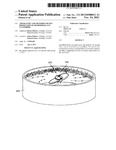
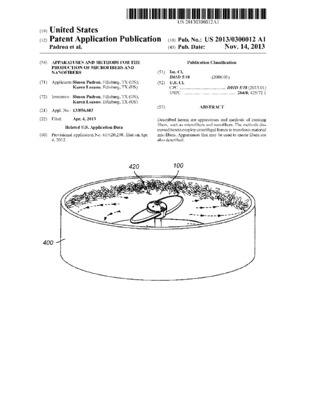
Apparatuses and Methods for the Production of Microfibers and Nanofibers
Simon Padron and Karen Lozano
Described herein are apparatuses and methods of creating fibers, such as microfibers and nanofibers. The methods discussed herein employ centrifugal forces to transform material into fibers. Apparatuses that may be used to create fibers are also described.
-
Seeds and Markers for Use in Imaging
Steven J. Frank and Karen Matirosyan
A contrast marker having a casing and a novel MRI contrast agent comprising metal complexes disposed around, within, or abuting the casing is provided. Such contrast markers may be placed in a strand, with or without a therapy seed, to produce a seeded strand useful for imaging and in connection with brachytherapy.
-
Methods and Systems for Analyzing Samples using Partical Irradition
Constantine Tarawneh, Nabanita Dasgupta-Schubert, and Michael Persans
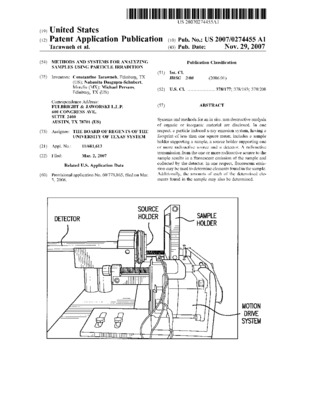
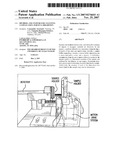
Systems and methods for an in situ, non destructive analysis of organic or inorganic material are disclosed. In one respect, a particle induced x-ray emission system, having a footprint of less than one square meter, includes a sample holder supporting a sample, a source holder supporting one or more radioactive source and a detector. A radioactive transmission from the one or more radioactive source to the sample results in a fluorescent emission of the sample and collected by the detector. In one respect, fluorescent emission may be used to determine elements found in the sample. Additionally, the amounts of each of the determined elements found in the sample may also be determined.
-
Method for Constructing Accurately Fitting Frameworks for Endosseous Implant-Supported Dental Prostheses
David R. Cagna, Robert E. Jones, and Rajiv V. Nambiar
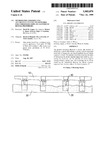
The present invention discloses a device and method of achieving a passive fit between a dental implant-supported metal bar or framework and dental implants located within a patient's mouth. The present invention comprises the steps of fabricating the dental implant-supported metal bar, contacting the metal bar and the plurality of dental implant analogs within a dental cast, and correcting the fit of the metal bar by inductively heating the dental implant-supported bar, thereby achieve the desired passive fit.
Printing is not supported at the primary Gallery Thumbnail page. Please first navigate to a specific Image before printing.